Building Wealth Through Business and Investing: Fabio Faccin's 10-Year Journey From Zero
A lot of conversations about financial independence start with privilege — an inheritance, a lucky break, a family safety net that made the first investment possible. Fabio Faccin's story starts with delivering pizzas in the rain.
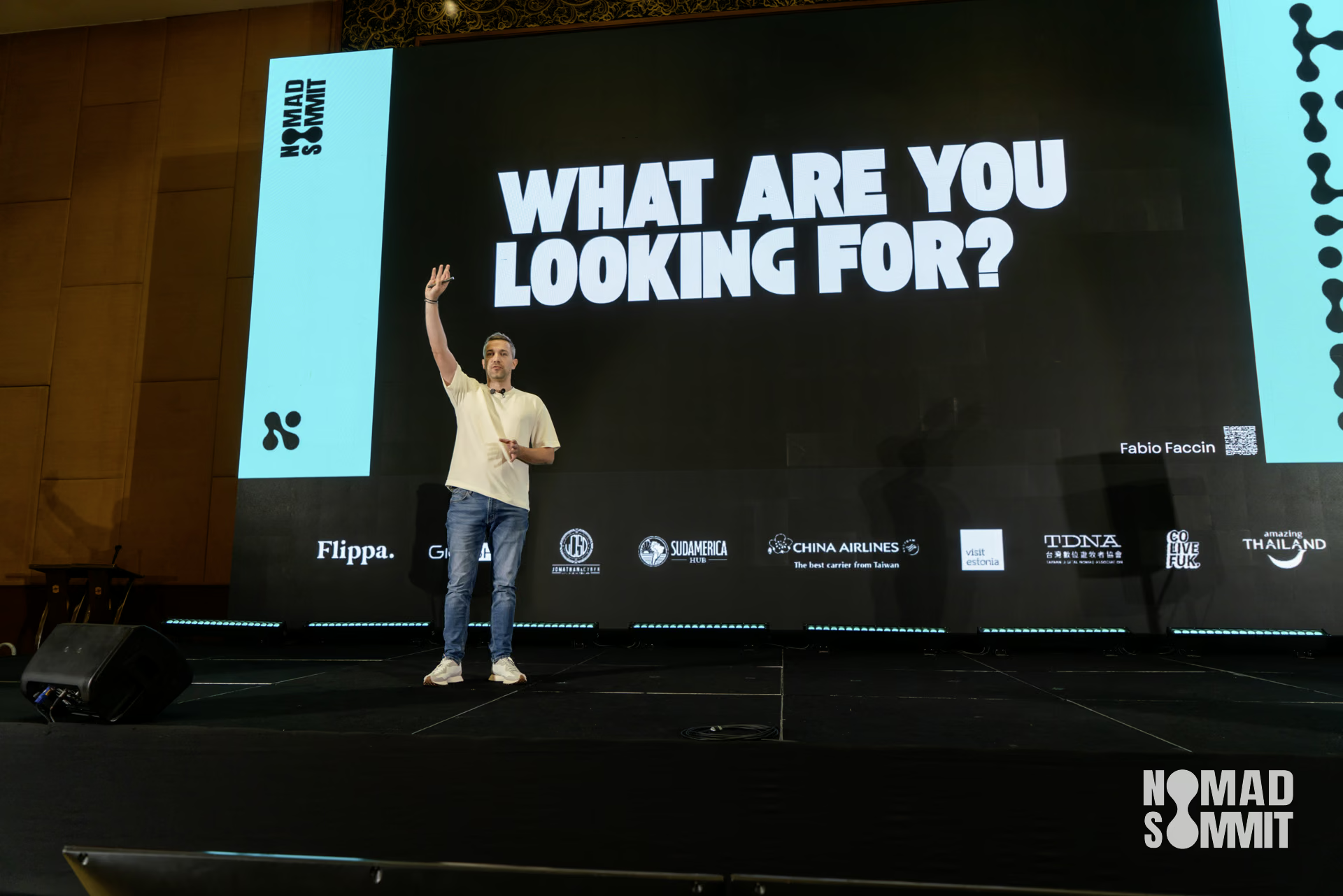
The Italian founder and digital advertising entrepreneur arrived at Nomad Summit with a clear, structured account of how he built his net worth from essentially zero to a point where his investments generate more income than his own monthly contributions. No inheritance. No lucky windfall. Ten years of deliberate accumulation — and a very specific philosophy about what freedom actually means.
What Freedom Actually Means
Before getting into investment mechanics, Faccin paused on a question that doesn't get asked often enough in communities like this one.
What are you actually working toward?
His answer was more concrete than "freedom" — a word he noted evolves over time. First you want freedom from poverty, so you work. Then freedom from a boss or an office, so you go remote or start a business. But at that point, you're still dependent — on clients, on revenue, on the next project. He described this as "a bigger, more shiny hamster wheel."
For him, real freedom is the ability to say no. No to people, places, and projects. Doing things by choice rather than necessity.
And that kind of freedom, he argued, can't come from a high active income alone. It requires a net worth that generates passive cash flow large enough to cover your living costs — so the wheel turns without you.
Two Phases Every Investor Goes Through
Faccin structured his entire talk around a simple framework: the accumulation phase and the distribution phase.
Accumulation is when you're building the machine — growing your net worth, reinvesting returns, letting compound interest do its work. Distribution is when the machine is running and generating cash flow without requiring ongoing effort. Most people in early-stage remote careers are somewhere in the accumulation phase and don't think clearly about what the exit looks like.
Understanding which phase you're in changes every decision you make — which assets to buy, how to structure your tax exposure, when leverage makes sense.
How He Actually Built It: A 10-Year Timeline
In 2016, Faccin started a freelance business as a digital advertising consultant. This was the foundation, and he was deliberate about it: the goal at the beginning wasn't to invest well, it was to earn significantly more than average.
He invested in professional training, conferences, and networking — not because these were fun expenses, but because they increased his income. Everything else, he kept lean. He resisted lifestyle inflation even as revenue grew, built a six-month emergency fund, and started small with bonds, stocks, and crowdfunding platforms. Some of that he lost money on.
In 2020, he relocated to Malta and optimised his tax structure. This freed up more capital to invest. He started putting more into ETFs and some crypto, and began looking at real estate flipping projects — not by buying entire properties himself, but by participating in collective investment vehicles with as little as €10,000–20,000.
Then 2024 hit what he called the compound interest turning point.
He was contributing around €1,500 per month into ETFs. That year, his monthly investment returns exceeded €2,000. His contribution had become less significant than what the portfolio was generating on its own. That shift — the moment passive growth outpaces active contribution — is what the accumulation phase is building toward.
From that point, he shifted toward distribution assets: buy-to-let properties in Spain and dividend stocks.
The FIRE Number: Knowing Your Target
One of the more practical moments in the talk was Faccin walking through how to calculate your own financial freedom number.
The framework is simple: take your annual living expenses, multiply by 25. That's the net worth where a 4% annual return covers your costs indefinitely. For Faccin, spending roughly €30,000 per year, the number is €750,000.
The point isn't that everyone has the same number — it's that most people are trying to reach financial freedom without having defined what it actually looks like for them. Working toward a target you've calculated is different from vaguely hoping things work out.
What Most People Do Wrong
Faccin spent a notable portion of his talk on common mistakes, not as a lecture but as an honest account of what he observed — and sometimes experienced himself.
The most common pattern: someone accumulates their first €5,000–10,000 and immediately starts looking for fast returns. Crypto trading. Speculative bets. And more often than not, they lose it.
He cited Warren Buffett — "You can't produce a baby in one month by getting nine women pregnant" — to make the point that time is structural to wealth-building, not a variable you can optimise away.
The second mistake is spending for status. When a bonus arrives, the instinct is to spend it. The people who build wealth over time, he argued, think about the opportunity cost — what that money would produce if invested instead of spent.
The third is misunderstanding debt. Most people treat all debt as bad. But debt that generates positive cash flow — a mortgage on a property that earns more in rent than it costs to service — is structurally different from consumer debt. It's a tool, not a trap.
Faccin noted that he still lives in a rented apartment. He deliberately preserved his debt capacity to take mortgages on income-generating properties rather than using it on a home to live in. That's a cost-opportunity calculation most people don't run.
The Investment Stack He Actually Uses
Faccin was careful throughout to note he's not a financial advisor — this is his own experience, not a prescription. With that caveat in place, he walked through his investment structure in a way that was unusually concrete.
Emergency fund first. At least six months of living costs, held in safe, liquid assets — deposit accounts, bonds. For him, roughly €15,000. This isn't an investment; it's a foundation that prevents you from liquidating investments at bad moments.
ETFs as the core. Global ETFs were and remain his primary vehicle. The logic is straightforward: one product gives you exposure to roughly 2,000–2,500 companies globally. In the long run, the global market has grown. You're not betting on individual companies; you're buying the overall trajectory of the market.
When evaluating ETFs, he focuses on fund size (bigger is safer), cost (lower is better), and distribution type. Accumulating ETFs reinvest dividends and are more tax-efficient — better during the accumulation phase. Distributing ETFs pay dividends out to you, making them better suited to the distribution phase when you want cash flow.
Single stocks and crypto as a smaller, speculative layer. A portion he treats as higher-risk, higher-upside positions. Not the core, but present.
Liquidity reserve of 10–15%. Always held back to move on opportunities — market dips, distressed sellers, time-sensitive deals.
Real estate after reaching €250,000 net worth. His reasoning: real estate requires more capital and is far less liquid than ETFs. If you need to sell quickly, you can't. That illiquidity is less of a problem once your financial base is solid. Before then, the flexibility of ETFs matters more.
Dividend stocks as he approaches his FIRE number. Companies like Coca-Cola, Procter & Gamble, Unilever — historically stable, with growing dividends. He showed an example where a €98,000 portfolio in dividend stocks generates approximately €5,000 annually in passive income.
Real Estate: Two Deals, Two Strategies
Faccin owns two buy-to-let properties in Spain, and he walked through both with specifics that made the talk noticeably more useful than most real estate discussions.
The first was an old apartment near the University of Alicante. He converted a living room into a fourth bedroom, added a second bathroom, and renovated the whole unit. Total investment: €145,000 — but thanks to a 60% mortgage (the maximum available to him as a non-resident), he put in €90,000 of his own capital. That produced a 15% annual ROI on his invested capital, with additional property appreciation of 15% in the first year.
The second was a different kind of deal. A seller in Valencia was under serious financial pressure and needed to close in ten days. Faccin used his liquidity reserve, bought in cash, then refinanced with a mortgage afterward to free up capital. Because the seller had urgency, the purchase price was below market value — at the moment of signing, his net worth increased by €25,000. The property has since appreciated 24% in a year.
He also introduced the concept of participating in flipping projects — where investors pool capital to buy, renovate, and sell a property, without managing the process themselves. Entry points can start around €10,000–20,000, making real estate accessible before you have the capital to buy outright.
The Leverage Argument
The most counterintuitive part of the talk was the case for mortgage debt, illustrated with a clean table.
Buy a €200,000 property outright, earning €15,000 in net rent: that's a 7.5% return. Buy the same property with €40,000 equity and a €160,000 mortgage at 4% interest, netting €8,600 after interest payments: that's a 21.5% return on your actual capital deployed. Nearly three times the return.
Extend that logic further: €200,000 of capital could fund five properties with mortgages rather than one bought outright. The bank's money amplifies your returns. That's not reckless — it's the mechanism behind most serious real estate wealth-building.
Which requires, of course, that the rental income reliably exceeds the mortgage servicing cost. That's why market selection matters, and why Faccin focuses on growing markets with measurable price appreciation.
The Bigger Question He Left the Room With
Near the end, Faccin asked something worth sitting with: are you building something that can work without you?
For most people working online — freelancers, consultants, small agency owners — the answer is no. The income is real, but it depends entirely on continued effort. That's a better situation than a traditional job in some ways, but it's still not freedom as he defined it.
The accumulation phase is about changing that answer. Not overnight. Over time, and with a clear number in mind.
He ended simply: you don't need to be born rich to live the life you want. But you do need to be deliberate, patient, and willing to understand how money actually works — including the parts that feel counterintuitive at first.