
How to Get Found When Nobody's Clicking Anymore
For twenty years, online visibility followed a predictable formula. Show up in search results. Get the click. Drive traffic. Everything downstream — leads, sales, awareness — depended on that click happening.
That formula is breaking.
Roughly 60 percent of search experiences now end with zero clicks. Not because users gave up — because they already got what they needed. AI answered the question before anyone had to visit a website. Which means that if your business is merely referenced as a source somewhere, you might effectively be invisible.
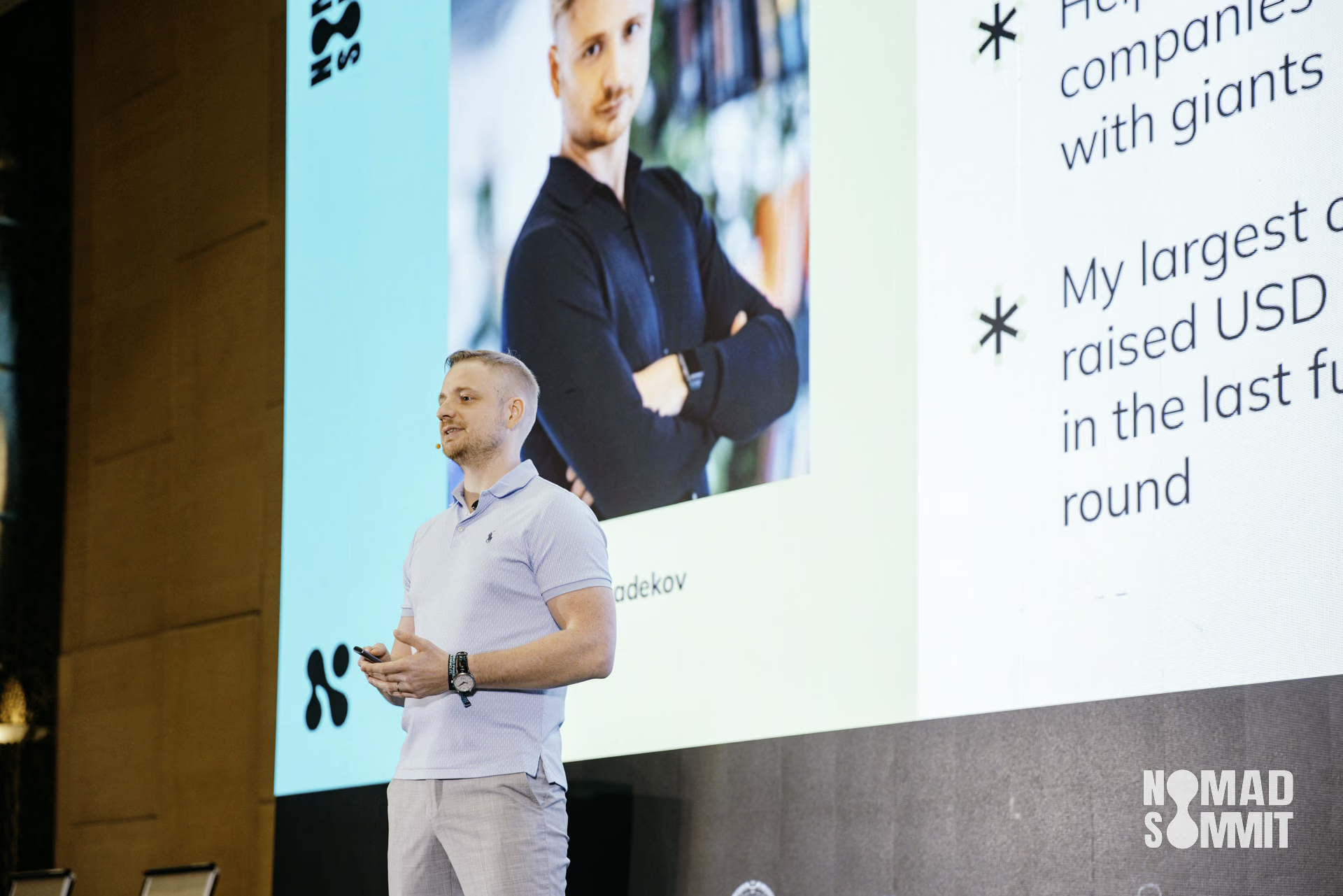
At Nomad Summit 2025 in Chiang Mai, Konstantin Sadekov — an SEO practitioner since 2009 and founder of an AI SEO agency working with startups and enterprises across the US and Europe — walked through what this shift actually means in practice, and what businesses should be doing about it right now.
The Click Is No Longer the Goal
The shift Sadekov describes isn't theoretical. He co-runs a permanent makeup studio in Tallinn with his wife, and last month five new leads arrived saying they found the studio through ChatGPT. Not Google. Not a referral. Not an ad. A large language model recommended them unprompted.
"We ask every new client how they heard about us," he said. "And we started hearing: ChatGPT recommended you."
For a local beauty business in Estonia — not a tech startup, not a venture-backed SaaS — that's a meaningful signal. The behavior is already there. Most businesses just haven't noticed it yet because they're not asking the right questions.
Semrush forecasts that by 2028, roughly 75 percent of search-influenced purchases will involve an AI recommendation before a wallet opens. Not AI completing the purchase — but AI shaping the consideration set before the customer ever reaches a product page. Three out of four potential customers, pre-filtered by a model they've learned to trust.
That changes visibility completely.
Three Types of AI Search — and Why They're Different
Sadekov breaks AI search into three distinct modes, each with its own logic:
The Push — AI Overviews from Google. The user searches, and Google surfaces a synthesized answer above the results. Here, the goal is to become the definition. Not to rank — to be the sentence or phrase the model lifts as the authoritative explanation. Generic introductions don't get featured. Specific, definitional writing does.
The Pull — Conversational models like ChatGPT and Gemini. Users engage in deeper discussion, asking follow-up questions. This is where the fan-out strategy matters: anticipating not just the primary question, but every question the user will ask next. Someone researching a Portuguese D7 visa will ask: do I become a tax resident? Can I bring my spouse? What's the healthcare situation? A piece of content that addresses the full arc of that inquiry gets cited more. A piece that answers only the headline question gets skipped.
The Engine — Citation-first tools like Perplexity. Here, the model is actively searching for and linking sources. Being a legible, trustworthy data source matters more than anything else.
The important detail: these are not the same as Google. A study Sadekov referenced shows 91 percent overlap between Perplexity citations and Google's top results — so traditional SEO still applies there. But for Google's AI Mode and ChatGPT, the models frequently surface sites that don't rank highly in conventional search. Different signals. Different optimization logic.
How LLMs Actually Choose What to Surface
Sadekov offered a useful reframe for understanding what's happening under the hood.
Traditional search, he explained, is like asking a librarian to bring you ten books on a topic. You browse and find the answer yourself. LLMs do something different: they take in potentially hundreds of sources, synthesize them, and deliver a single answer. You never see the books.
Which means traditional SEO tactics — optimizing to make sure the librarian picks up your book — are necessary but no longer sufficient. Two things now matter more: making your content easy for the model to parse and extract from, and getting your brand mentioned in the authoritative sources the model already trusts.
The underlying mechanism is vector embeddings — a mathematical way of measuring the conceptual distance between words and ideas. Models aren't reading your content the way a human does. They're mapping concepts into a kind of dimensional space and evaluating which sources are most semantically coherent, dense, and trustworthy relative to a given query.
Which sounds slightly abstract until you realize it has very concrete implications for how to write.
Structure Is an Optimization Variable
AI models, Sadekov pointed out, are computationally expensive. They have token limits. They're essentially lazy by design.
Put the most important information about your business in the first 30 percent of any page. Not buried in section four after a long preamble — first. Because if the model doesn't encounter it quickly, it may not weigh it at all. Every paragraph should target a single distinct idea. Chunked, legible, semantically discrete.
He also made a point about freshness that most content teams get backwards. Content updated every three months gets cited 20–30 percent more often than static pages — but the response to this isn't to publish more new content. It's to update existing content. Most marketers push for volume: ten new articles this month, twenty next month. The more useful investment is revisiting strong existing pages and keeping them current. That one change probably has more LLM impact than any new piece you'd write.
A few other structural considerations he flagged:
- Lead with keywords or identifying terms in the first 40 characters of a page or section — not a generic opener
- Replace vague language with specific data: not "it's hot" but "average temperature is 32 degrees"
- Write under real author names, with visible credentials and expertise signals — models are beginning to weight author authority
- Collect reviews on platforms like G2, Capterra, Clutch, and Trustpilot — these function as third-party trust signals
The Brand Mention Is the New Backlink
One of the most practically useful ideas in the talk: you don't need a backlink to train an LLM on your brand. You need a mention.
Sadekov's approach — used for both his own studio and his B2B clients — involves publishing listicle-style articles. "Top 5 permanent makeup studios in Tallinn." "Top 8 subscription management tools." Articles that, when indexed, put your brand name into the training corpus in a positive, contextually appropriate setting.
These articles do double duty. They feed LLMs with brand associations, shaping how models respond to relevant queries. And they rank in conventional search too — so readers who land on them discover your brand as a recommended option. The mention is training data and marketing simultaneously.
The implication is that brand-building and LLM optimization have converged. Getting mentioned in credible, well-structured content across the web — Reddit, Quora (which is translated into 28 languages), YouTube, niche publications — isn't just PR anymore. It's how you show up in AI-generated answers.
Measuring the Dark Funnel
This is where things get genuinely messy, and Sadekov was candid about it.
A chunk of AI-influenced traffic is invisible by nature. A user asks ChatGPT for a recommendation, gets a brand mention, then goes directly to Google and searches that brand name. In GA4, that shows up as branded search or direct traffic. There's no LLM attribution. The influence happened — it just left no trace in the data.
You can filter GA4 to see referral traffic from LLM platforms, which captures some of it. There are also newer tools that attempt to simulate how models respond to prompts relevant to your business — measuring how often your brand surfaces. Sadekov's honest assessment of those tools: they're largely vanity metrics right now. They query models through API access, which doesn't reflect what real users see. Even a single different word in the prompt changes the output. The data isn't reliable enough to act on at scale.
His recommendation: self-attribution forms. Ask people directly how they found you, and leave the field open-ended. It's low-tech. It works. And it catches the dark funnel signals that no software is reliably tracking yet.
Messier attribution, perhaps. But very real behavior.
Writing for Machines — Which Was Always About Writing for Humans
Sadekov ended with something slightly unexpected for an SEO talk. A personal note about visibility — not algorithmic visibility, but the more human kind.
He mentioned being born with a hand injury and spending years avoiding visibility: new people, public speaking, putting himself out there. The irony of spending a career optimizing other people's visibility while hiding his own wasn't lost on him.
But the professional point lands too. For twenty years, the received wisdom was: write for humans, not machines. It turns out the machines are now reading everything, synthesizing it, and deciding what gets surfaced to humans. The best response to that isn't to write differently — it's to write with more clarity, more specificity, more genuine authority. Which, as it happens, is also what humans respond to.
The businesses that adapt to this shift won't do it by gaming a new algorithm. They'll do it by becoming the clearest, most consistently cited, most structurally legible version of themselves on the web.
The models will notice. And so will the customers.
Sources & References
- Semrush — SEO and digital marketing analytics platform; source of the 2028 AI search revenue forecast cited in the talk
- Perplexity — Citation-first AI search engine that surfaces and links sources directly
- Google Analytics 4 (GA4) — Web analytics platform with referral traffic filtering for LLM sources
- G2 — B2B software review platform; cited as a trust signal for LLM visibility
- Capterra — Software review and discovery platform
- Clutch — B2B ratings and reviews platform for agencies and service providers
- Trustpilot — Customer review platform used as an external trust signal
- Quora — Q&A platform available in 28 languages; cited as a high-value brand mention channel for LLM training data
- Unium — Swedish B2B SaaS company referenced as a client case study for listicle-based LLM visibility strategy