How to Build a SaaS From the Niche You Already Know
Countless people waiting for the right moment to build something don’t have a resources problem. They have a permission problem — waiting to feel ready, waiting for the idea to be obvious enough, waiting for the technical skill to catch up with the ambition.
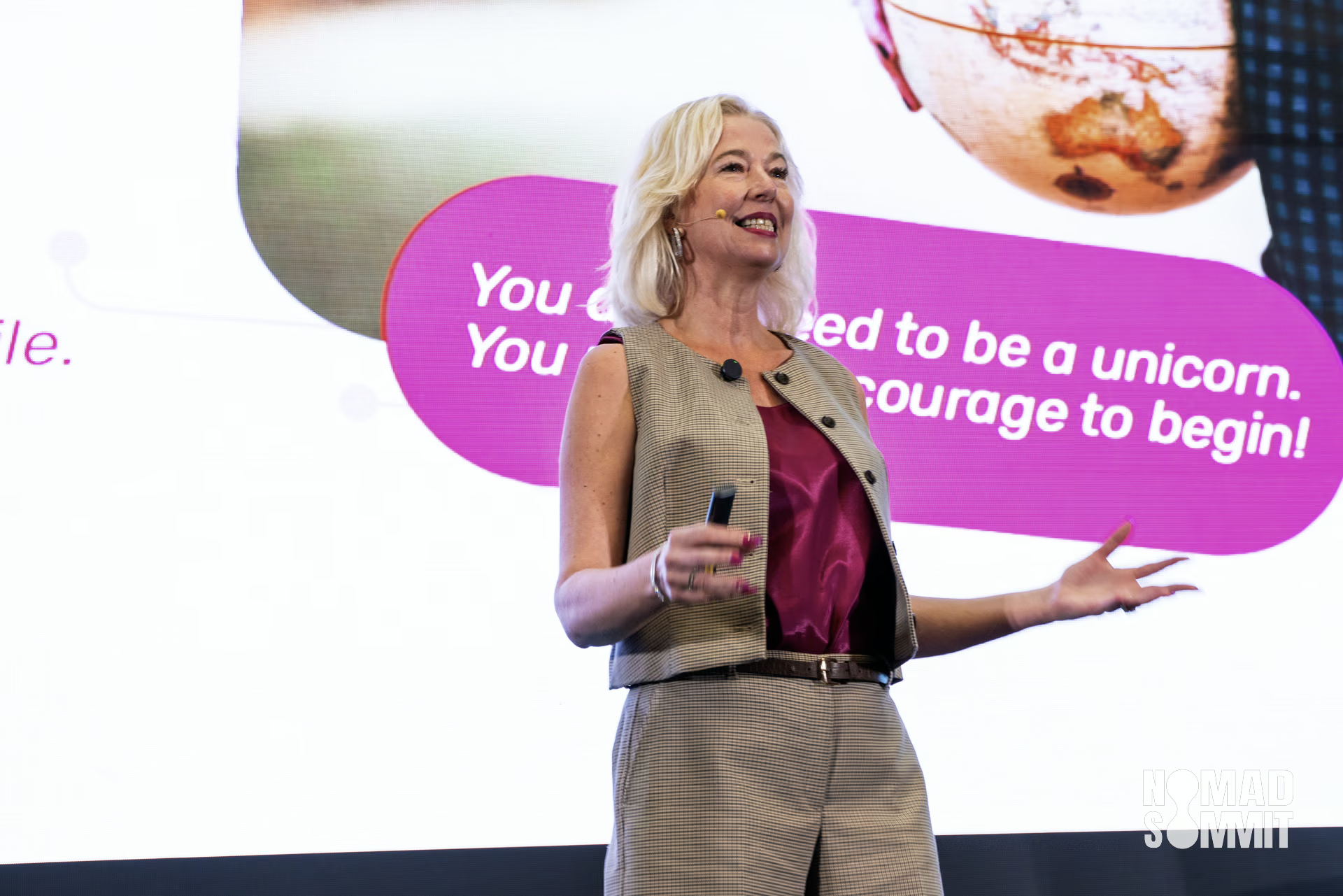
Vivianne Arnold's argument is simple, and she made it with some force at Nomad Summit 2025: the moment is already here, and you're already more prepared than you think.
That's not motivational filler. It's a practical claim backed by a specific shift — the barriers to building a scalable software product have dropped so dramatically that the advantage now belongs to people who know a niche deeply, not people with the biggest technical headcount.
The Myth That's Keeping You Stuck
There's a persistent image of what a SaaS founder looks like. It involves a nineteen-year-old in a hoodie, a deep engineering background, venture capital, and a unicorn exit strategy. Arnold's first move in her talk was to dismantle this picture.
You don't need bazillions in investor funding. You don't need a big team. And perhaps most usefully — you don't need to be a deep technical person to start.
What you need is focus, a very clear problem to solve, and the courage to start before you feel completely ready.
Arnold knows something about the distance between starting conditions and outcomes. She grew up on a remote sheep station in outback Australia — the only technology available was a CB radio. That's what her early education ran on. She went on to become a worldwide director at Microsoft, serve as CMO for Telstra, negotiate trade deals for the Australian government, and lead digital transformation work across APAC for companies like PayPal. She became a digital nomad before the term had settled into common use, starting in Japan as a recent university graduate.
The point isn't the career highlights. The point is that domain expertise compounds, and that accumulated knowledge is precisely what creates a defensible product. The technical parts can be hired or collaborated on. What can't be easily replicated is 25 years inside a specific industry problem.
One Problem, One Sentence
Before Arnold and her husband and co-founder Bruno built anything, they had run a successful creative agency — video production, social content, solid brand names. And they were exhausted by it.
The agency model is a hamster wheel, even when it's working. Finish one client, pitch the next. If you don't show up, you don't bill. There's no leverage, no compounding, no asset. When Arnold's mother had a stroke and the team relocated from Sydney to Adelaide, the fragility of that model became impossible to ignore.
Then AI hit. And instead of seeing it as a threat to their agency work — which it was, clearly — they saw it as the opening to build something bigger than themselves.
The problem they chose to solve wasn't abstract. It came directly from Arnold's background in marketing and sales leadership. For twenty-five years, people had been turning up at her desk with the same request: I need more content. Content for events, content for thought leadership, content for sales follow-up cycles. The bottleneck was never the writing alone — it was the approval process. A single piece of copy could take weeks to clear through social media managers, designers, PR leads, CMOs, product managers.
That's the problem she could articulate in one sentence: Creating tailored, engaging content that's scalable and cost-effective is genuinely difficult.
She's firm on this test. If you can't state your problem to be solved in one clear sentence, you're not ready to build yet. Not because the idea isn't good enough, but because the thinking isn't clear enough.
The Messy Middle Nobody Talks About
WiredMinds.ai, the AI-powered content platform Arnold and her husband built, reached MVP stage with real momentum. Because Arnold had been building in public — sharing the founder journey on LinkedIn before the product launched — prospects were already coming to them.
Then came what she calls the messy middle.
A major brand with thousands of users across multiple countries came into the picture. There were twenty people in the pitch across multiple time zones. The APAC CMO shook Arnold's hand at the end and said they were going to win awards together. And then: silence. Weeks, then months, of follow-up emails and calls that went nowhere.
It eventually emerged the company had taken her product ideas into an internal hackathon, attempted to replicate them, and stalled. Six months later, nothing was built. But a significant amount of Arnold's time, energy, and product development had already been redirected toward their specific requests — including a custom feature for processing large industry reports into personalised sales content, which she built and delivered on spec.
The lesson she draws from this is about ego. The first big brand name is an incredibly seductive prospect, and that pull can cost real resources if you're not careful. The ideal first customer looks different: fast to decide, clear on what they need, and not requiring twenty approvals across ten time zones.
Her actual first good customer was Mark, founder of an AI startup called Weatherit. He read her LinkedIn content, sent a direct message, and was on the platform inside a week. Two calls, done. That win gave her the momentum and the confidence to build toward the second client, and the third. Small wins compound in ways that chasing the big logo doesn't.
Why Niche Knowledge Is a Competitive Moat
The thing Arnold trained her AI agent on was her own expertise — 25 years of sales and marketing decision-making, campaign architecture, content strategy. That depth of domain knowledge embedded into the product is, she argues, something genuinely hard for a generalist platform to replicate.
This is the actual argument for building from a niche you already inhabit. Not just that you'll understand the customer better, though that's true. It's that the product itself can carry domain intelligence that took decades to develop.
What she discovered, somewhat unexpectedly, is that the product's reach was wider than her original mental model. She'd been focused on B2B sales reps using LinkedIn. But the same problem — producing credible, polished content efficiently — exists for consultants, content creators shifting platforms, and non-English-speaking professionals who want to position themselves in global markets but lack confidence in written English. The niche gave her the starting point; the market turned out to be larger.
The narrow focus early on wasn't a mistake. It was the mechanism that let her build something specific enough to be useful. The breadth came later, once the core was working.
Building Your Brand as You Build Your Product
Every single early lead at WiredMinds came through LinkedIn direct messages. Every one.
Arnold is an introvert by her own account. Getting on stage takes effort. But she's the face of her product, and she leans into that rather than around it. People don't buy software first — they buy belief, confidence, trust in the person behind it. The founder story matters, especially before the product has a track record.
Her brand visibility framework is straightforward: a current, face-forward photo; consistent storytelling about the founder journey; content that genuinely teaches or simplifies something for your audience; proof in the form of early client wins; and repetition. The repetition is the part most people underestimate. Consistency isn't glamorous, but it's what creates recall — and recall is what gets you the DM that turns into the first client.
If you're planning to launch an MVP at some point in the future, the time to start building your audience isn't at launch. It's now, during the build, with all the uncertainty and imperfection that comes with it. That authenticity is an asset, not a liability.
The Practical Argument for 2026
Arnold closed with something worth taking seriously: the barrier to building a scalable product has never been lower. The tools exist, the infrastructure is accessible, the cost of a wrong turn is recoverable. What tends to stop people isn't capability — it's the feeling of not being ready.
Autonomy without leverage is fragile. That phrase landed as the real point of the whole talk. Being location-independent and time-flexible matters a lot less if your income disappears the moment you stop showing up. The goal of the SaaS, the scalable product, the thing that works while you're walking the dog on the beach — that's the leverage part. It's what makes the lifestyle durable rather than precarious.
You don't need a unicorn ambition to get there. You need a clear problem, a niche you know well, the courage to start before everything is perfect, and the willingness to build in public while you build the product.
That combination, Arnold would say, is already enough.
Sources & References
- WiredMinds.ai — AI-powered content generation platform for sales and marketing teams, co-founded by Vivianne Arnold
- Weatherit — Weather insurance platform for outdoor events and experiences, founded by Mark