
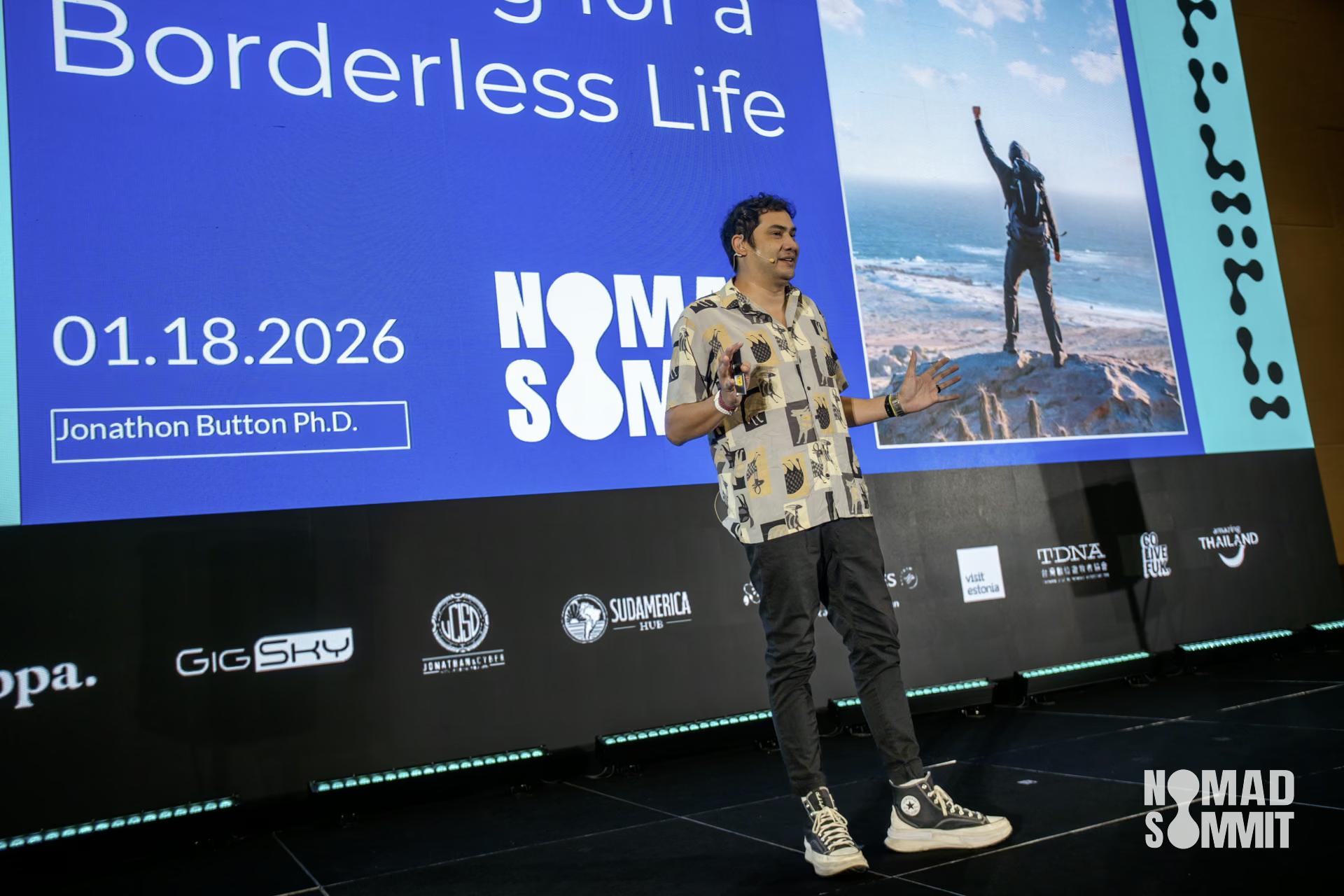
Modern Investing for a Borderless Life
Most investment portfolios are built around the life you're already living. The problem is that life has a habit of changing — and the world, it turns out, can change even faster.
That's the realization Dr. Jonathon Button arrived at somewhere between his PhD program and a growing sense that the future was moving in a direction his investments weren't pointed at. Not because anything had gone wrong. But because he looked at his portfolio and saw a reflection of the past rather than a bet on what was coming next.
That gap — between the life people are building and the investments meant to support it — is what his talk at Nomad Summit was designed to close.
When Your Portfolio Doesn't Reflect Your Life
Button's starting point is personal. During his PhD at Oklahoma State, he and his wife Quinn had built a portfolio that made sense — for a different version of themselves. They were location-dependent, so they held real estate. They were aiming for long-term stability, so they leaned into safe stocks and ETFs. Rational choices, made at a rational time.
Then came the realization that the world was shifting faster than their investments were.
It wasn't a financial crisis that prompted the rethink. It was clarity. Systems change. Technologies emerge and disrupt institutions people took for granted. And if you believe in a particular future, your portfolio should probably reflect that belief rather than contradict it.
That insight was sharpened by an encounter with George Gilder, the author of Life After Television — the 1993 book that described, with eerie precision, a device as portable as a watch and as personal as a wallet that would navigate streets, collect your news, and recognize speech. Everyone in that room, Button noted, was carrying one. Gilder's later book, Life After Google, deepened the lesson: not that Google was about to collapse, but that technologies like blockchain have the potential to quietly dent — or eventually disrupt — institutions we currently take for granted.
Two things followed from that encounter. One: some futures feel absurd until they don't. Two: investing is, at its core, an act of belief in a future.
The Concept of F-It Money
Button and his wife developed what he freely admits is an entirely unacademic concept: F-it money.
The idea is simple enough. You identify a small amount you are genuinely willing to lose. You place a deliberate, non-emotional bet on something you believe in — not because you're chasing returns, but because the logic holds up when you remove the emotion. Then you say goodbye to it and let it sit.
In 2020, during a stretch in Vietnam when the world paused and everyone had time to think, they laid out their investments and looked honestly at the results. The small, unconventional bets had, in their case, outperformed the "safe" positions. Not because they got lucky, but because the reasoning behind those bets had been grounded in a coherent view of where things were heading.
That doesn't mean everyone should follow the same path. Button is careful about this. Risk tolerance varies by age, lifestyle, financial resources, and what you actually want your money to do. The framework matters more than the specific positions.
Autonomy as the Real Return
Before getting into tools and tactics, Button makes a point that reframes the whole conversation. For most people in the room — nomads, by definition — the goal isn't wealth in the abstract. It's autonomy. The freedom to move, to choose, to live in the way they've decided is worth living.
Money is the mechanism. Autonomy is the dependent variable.
Which means the first question when reviewing any investment isn't "what's the return?" It's whether your portfolio is pointing in the same direction as the life you're trying to build. That alignment — or the lack of it — is where a lot of people quietly lose ground without noticing.
Level One: Take Control
Button structures his framework across three levels, starting with mindset and direct ownership.
His opening observation is that everyone in the room is already an investor, whether they think of themselves that way or not. Cash in a bank account is a position — a belief that holding that currency will serve you better than deploying it elsewhere. Doing nothing is still a decision. The question is whether it's a conscious one.
From there, his first practical recommendation is to stop outsourcing your investments entirely by default. Having a fund manager isn't inherently wrong, especially for people with complex or time-consuming lives. But no fund manager knows your values, your vision of the future, or your tolerance for risk as well as you do. And the management fees compound over time in ways that are easy to underestimate.
Mobile investing platforms have changed what's possible here. Robinhood, eToro, Webull — these tools put commission-free trading in your pocket, available around the clock, across time zones. The friction that once made direct investing impractical for nomads has largely disappeared. Button's recommendation is simply to have some form of investment app accessible so that when you see an opportunity, you can act on it in the moment.
Level Two: Access, Not Hype
The second level is where things get more interesting — and where Button is careful to distinguish between access and hype.
Crypto has a reputation, and a fair portion of it is deserved. Scams are real. Hype cycles come and go. But Button's argument isn't about crypto as a speculative asset class. It's about what on-chain infrastructure actually enables for someone living across borders.
Tokenized stocks — crypto assets backed one-to-one by real equities traded on US markets — give people in countries with heavy investment restrictions a way to get exposure to assets that would otherwise be completely inaccessible. No KYC requirements. No geographic gatekeeping. Just internet access and a wallet. Whether that's gold, silver, uranium, carbon credits, or US equities, the on-chain layer removes friction that the traditional system quietly imposes on people depending on where they were born.
There's also the question of early-stage projects. OpenAI and SpaceX are the examples Button reaches for — companies that most people would invest in immediately if they could. They can't, because regulatory structures keep those opportunities gated until public listing. On-chain equivalents exist, carrying substantially higher risk, but also providing a kind of access to early-stage upside that simply wasn't available to retail investors a decade ago. The more embedded you become in those communities — the more events you attend, the more people you talk to — the better positioned you are to distinguish the logical bets from the noise.
He also touches on prediction markets, platforms like Polymarket, which allow users to take positions on the outcomes of future events. Legally ambiguous in places, and easy to dismiss as gambling. But Button's use case is more practical: he uses them as a signal tool, not a primary investment vehicle. If you want to understand what the market considers the most likely future outcome on a given question, prediction markets give you a surprisingly clean read on collective probability estimates.
And then there are collectibles. Baseball cards, trading cards, rare physical assets — not exactly portable in a backpack. But platforms now exist that let you buy digital certificates of ownership for physical items held in insured, secure vaults. You hold the certificate; someone else holds the object. When you want to sell, the buyer can take physical possession or continue holding the certificate. It's a small but telling example of how the asset class itself is becoming borderless.
Level Three: On-the-Ground Intelligence
The third level is what Button and his wife have turned into a practice: attending tech conferences, systematically, as a form of investment research.
They aim for a new conference roughly every thirty days. The goal isn't networking in the conventional sense — it's pattern recognition. You have conversations, gather qualitative insight, and begin to notice when the same themes emerge across different locations and different events. Those recurring signals, stripped of the noise that surrounds any single conversation, start to feel like something worth paying attention to.
For nomads, this is a structural advantage that most people don't fully use. The ability to move quickly, to show up at a conference in Kuala Lumpur or Chiang Mai or wherever next month's opportunity is, puts you in proximity to information that hasn't made it online yet. On-the-ground insight tends to precede public information by enough of a margin to matter.
For people who can't or don't want to travel to major conferences, Button points to local incubators, innovation hubs, and accelerators as alternatives. Coworking spaces increasingly function as early-signal environments. And even at the smallest scale, Meetup and Eventbrite surface local gatherings where the conversations, if you're paying attention, often reveal what's quietly gaining traction before it becomes obvious.
AI becomes useful at the point of synthesis. Button captures conversations — sometimes via a wearable device that transcribes on demand — converts them into mind maps, and eventually into investment reports. The AI's role isn't to make decisions. It's to help structure the information, identify patterns, and reduce the human bias that creeps into any analytical process when you're already leaning toward a particular conclusion. Which is most of the time, if you're honest about it.
The Practical Summary
Button closes with five principles that compress the framework into something usable.
Exposure comes from access, not expertise. The tools exist. Using them is the prerequisite for everything else.
Patterns matter more than timing. This is a long game, and recognizing recurring themes across markets, conferences, and conversations is more durable than trying to hit a specific entry point.
Small, intentional bets beat all-or-nothing decisions. The F-it money concept applied consistently — logical, non-emotional, appropriately sized — tends to outperform the paralysis of waiting for certainty that never arrives.
Consistency does the heavy lifting. Buy more than you sell. Think in decades, not quarters.
And the one that anchors all the others: autonomy is the real return. Not the percentage gain. The freedom it enables.
Investing That Matches the Life
The argument Button is making isn't complicated, but it tends to get obscured by the noise of markets and tactics and asset classes. A portfolio that reflects where you used to be — or where someone else thinks you should be — is a poor fit for the life most nomads are actively building.
Aligning investments with an actual vision of the future requires taking some ownership of the process. Not necessarily doing everything yourself. Not necessarily taking on more risk than you're comfortable with. But being deliberate about what you believe, and making sure the money you're working to free up is pointed in the same direction.
Autonomy doesn't start with money. It starts when your investments finally align with the life you've chosen.
Sources & References
- Robinhood — Commission-free mobile investing platform for stocks and ETFs
- eToro — Social trading and multi-asset investment platform
- Webull — Commission-free stock and ETF trading platform with extended hours
- Polymarket — Prediction market platform for betting on real-world event outcomes
- Meetup — Platform for finding local in-person community events and gatherings
- Eventbrite — Event discovery and ticketing platform for local and global events