Landing Remote Jobs in a Competitive Market
Something has changed in how people find remote work — and most job seekers haven't caught up yet. The old playbook, mass-applying through job boards, waiting to finish that next certification, assuming any remote role will do, is producing predictably bad results. The market is more crowded than ever. The strategies that once worked are now just background noise.
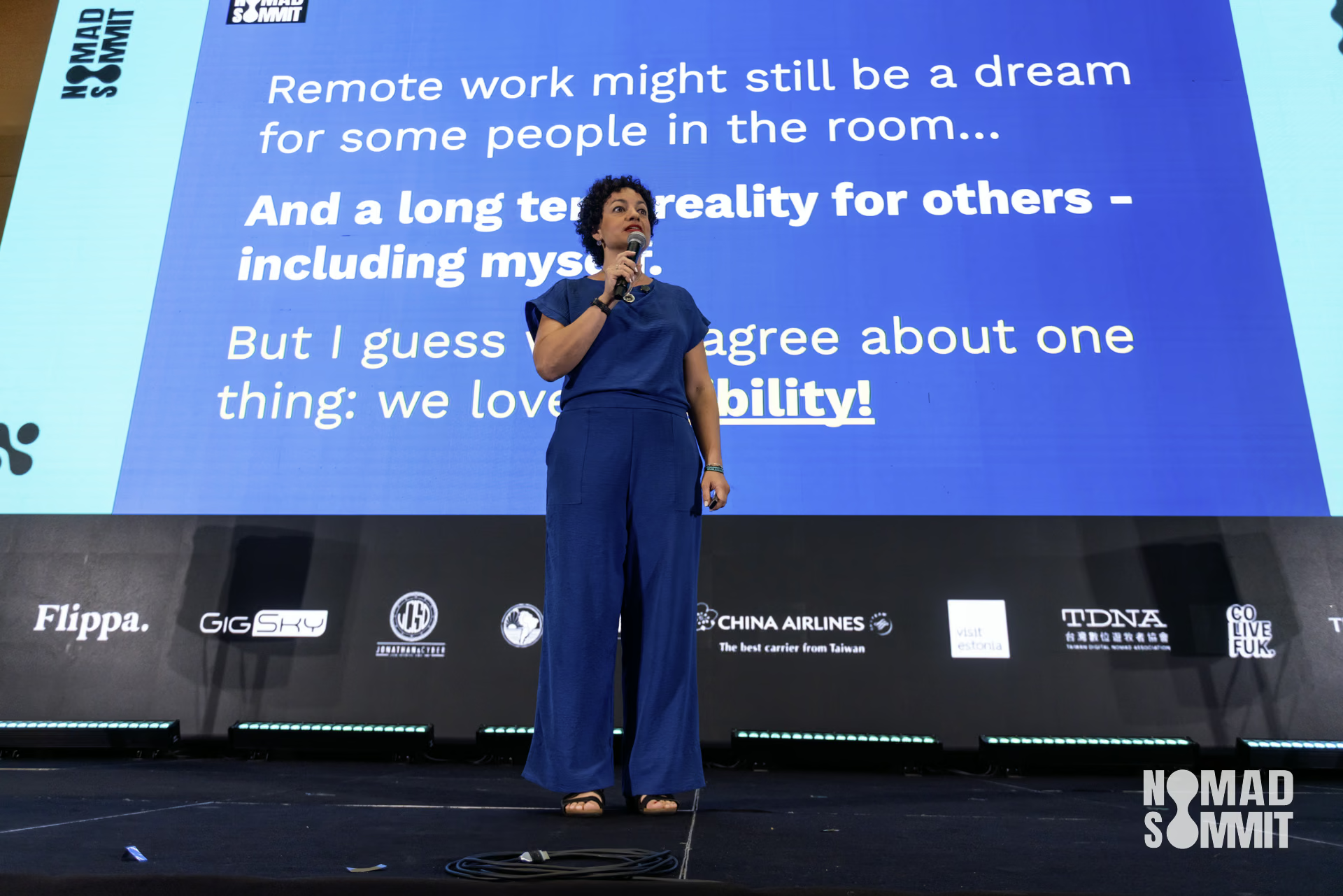
Juliana Rabbi has spent over a decade working remotely, starting in 2014 when her employer gave her an ultimatum that accidentally changed her life. At Nomad Summit 2026, she walked through five common mistakes people make when searching for remote work — and the concrete strategies that replace them.
Mistake One: Accepting Any Remote Job Instead of the Right One
The desperation mode is understandable. Remote work feels like the goal, so any remote role looks like a win. But this framing is backwards.
Companies aren't hiring people because those people want to work remotely. They're hiring people who can solve specific problems, meet real requirements, and fit the role well. Wanting flexibility isn't a value proposition.
There's also a less obvious layer to this: not all remote jobs are built the same. Some require you to stay in a fixed time zone. Some assume you'll be available in specific windows. If you want to travel and work across multiple countries, that's a different job search than someone who just wants to skip the commute. Conflating those two paths leads to frustration on both sides.
The fix is deceptively simple: get specific before you start applying. Rabbi calls this the what, must-haves, and where framework. What problems can you actually solve as a professional? What are your non-negotiables — schedule flexibility, time zone, team structure? And where do those jobs live? Which types of companies offer that combination? Until those three questions have real answers, the job search is just noise.
Mistake Two: Doing What Everyone Else Is Doing
The LinkedIn Easy Apply button is a marvel of frictionless UX. It is also, for most applicants, a dead end.
When a single entry-level remote role attracts over 1,300 applicants — which is a real number Rabbi shared, not a hypothetical — being applicant number 672 or 1,100 doesn't meaningfully differ. The spray-and-pray approach, sending out dozens of identical applications and hoping someone notices, is the baseline behavior. Which means it produces baseline results.
The alternative is positioning plus visibility. Those are different things, and both matter.
Positioning means showing how you solve problems, not just listing what tasks you've performed. Rabbi's client Deborah rewrote her LinkedIn headline to lead with impact: "helped 50+ brands grow with copy that converts and creative strategies." That's not a job description. It's a signal to the right person that she's worth a conversation. Within four months, Deborah had four fully remote job offers and chose the one that doubled her salary.
Visibility means being in the right places — LinkedIn, professional communities, in-person events — so that recruiters and hiring managers encounter you before they're actively hunting. Tailoring your resume and profile for specific remote roles, using language that signals remote-work readiness (distributed teams, async communication, virtual work environments), and adding concrete results rather than vague responsibilities all contribute. It's slower work than clicking Easy Apply. It's also significantly more effective.
Mistake Three: Waiting to Have the Perfect Qualifications
This one is subtle because it looks like responsibility. I'll start applying after I finish this certification. I'll reach out once I have more experience. The logic feels sound — be ready before you show up.
But in practice, it's often a way of avoiding the discomfort of actually starting. Rabbi talked to someone just days before her talk who was delaying her remote job search because she didn't yet have a specific certification. The assumption was: get the credential, then search. The reality is that most job seekers overestimate what's actually required versus what's simply "nice to have."
The strategy here is what Rabbi calls the spotlight shift — moving attention from what you're missing to what you already have. Map the actual job requirements for the roles you want. Separate the mandatory from the desirable. Then look at your existing experience and find the transferable skills that apply across industries or contexts. Those skills, articulated well, are often more than sufficient to start applying.
And for genuine gaps? Learning fast with available tools — YouTube tutorials, books, structured prompting with AI — isn't the same as formal certification, but it's often enough to demonstrate familiarity. Waiting six months for a credential before sending a single application is almost never the right call.
Mistake Four: Having No Connections at the Companies You Want
The hidden job market is real. A meaningful share of roles get filled before they're ever posted publicly — through referrals, existing relationships, and people who were already on a hiring manager's radar. If the only way you're engaging with remote companies is through job board listings, you're seeing an incomplete picture of what's available.
Rabbi was direct about this: if no one at a target company has ever encountered your name, you're just another number in the applicant queue. She shared her own LinkedIn data as illustration — seven connections at Zapier, zero at DuckDuckGo. If she were applying to both today, those numbers would meaningfully affect her odds. Not because of any formal referral process, but because visibility within a company creates a very different starting point.
The practical implication is to build relationships at target companies before a job opens up. Connect with recruiters and hiring managers. Engage with their content. Reach out to former colleagues who might have moved into those organizations. This isn't about gaming a system — it's about being a real person in a network rather than a file in a queue.
And it's worth being clear with your existing network too. Rabbi's closing action items included one that sounds almost too obvious: tell people you're looking. Be specific about what you want. That conversation, had honestly, surfaces opportunities that never make it onto a job board.
Mistake Five: Assuming Remote Work Means Lower Pay
This one is mostly a mindset problem. Some candidates assume they'll need to accept a salary cut in exchange for location flexibility — that remote work is inherently a junior-tier or call-center-adjacent category. That assumption tends to constrain the jobs people even consider applying for.
It's simply not accurate. Remote roles span the full salary range, including senior and well-compensated positions. Treating remote work as a tradeoff rather than a genuine career option leads people to undersell themselves before they've even started negotiating.
The reframe Rabbi offered is straightforward: remote work doesn't require a step backward in your career. The level of role, the quality of the company, the compensation — none of those are inherently diminished by the absence of a physical office. Adjust expectations accordingly.
What to Do This Week
Rather than leaving the framework abstract, Rabbi closed with three specific actions for anyone serious about the job search.
First, write down your non-negotiables — the actual must-haves for your next role in terms of schedule, time zone, team structure, and type of work. Second, review your LinkedIn profile and make sure it reflects remote work experience or remote-ready skills, not just a list of past job duties. Third, reach out to two or three people in your network and tell them, specifically, what kind of remote work you're looking for.
None of those require a new certification. They require clarity and a willingness to start.
Where the Market Is Heading
Rabbi's predictions for 2026 and beyond aren't particularly optimistic in terms of difficulty — global competition for remote roles will keep increasing, and companies with access to worldwide talent will grow more selective. But the underlying logic doesn't change: positioning matters more than volume, relationships matter more than cold applications, and visibility is increasingly the thing that separates candidates who get calls from those who don't.
Async work across time zones is becoming more common, not less. Hybrid options are proliferating. The remote job market is maturing, which means the informal shortcuts that worked five years ago are being replaced by a more sophisticated hiring environment.
That's not a reason to be discouraged. It's a reason to be strategic rather than reactive — to do the specific, unglamorous work of positioning yourself well before the job posting appears, rather than scrambling alongside a thousand other applicants after it does.
The competition is real. The opportunity is also real. The difference, more often than not, comes down to whether you were visible before you applied.
Sources & References
- LinkedIn — Professional networking platform widely used for remote job searching and recruiter outreach
- Zapier — Fully remote company specializing in workflow automation, frequently cited as a remote-work employer
- DuckDuckGo — Privacy-focused search engine and remote-first company