How to Own Your Business Journey: Lessons From 5 Business Models
Many people thinking about working for themselves get stuck on one question too early: what kind of business should I start? They jump straight into models and mechanisms before settling the more fundamental question underneath — who are they, what do they actually want, and what do they already carry with them?
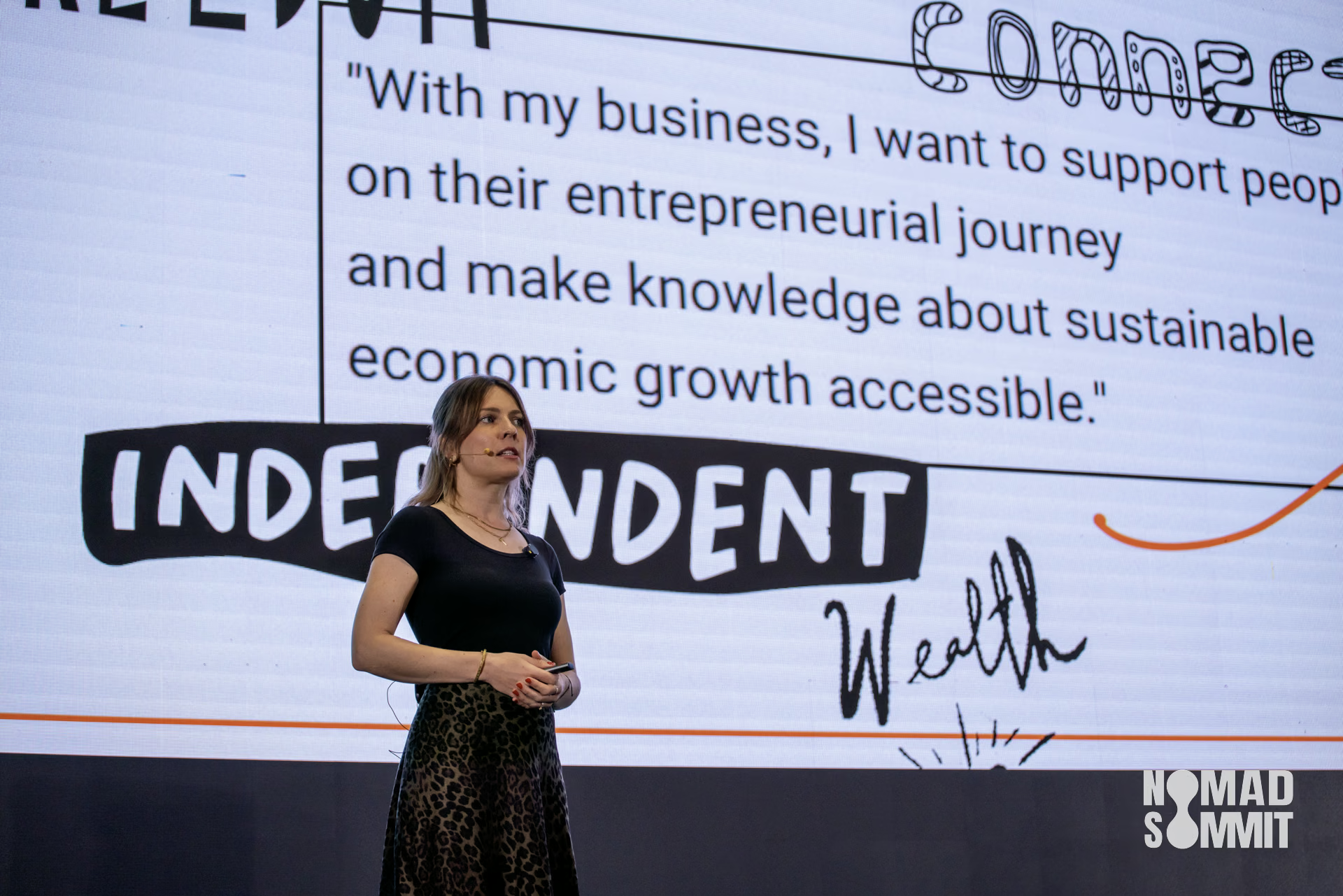
Stella Schneider, a German-born business coach and solopreneur, has spent eight years working through that question herself. At Nomad Summit Chiang Mai, she laid out the framework she uses with clients: a structured look at the five most common business models for location-independent workers, grounded in a rigorous honest look at yourself before you pick any of them.
Start With You, Not the Model
Schneider opens with a three-layer foundation she calls the basis for any business decision. At the bottom: vision. What do you actually want your life to look like? In the middle: values and belief systems — including the country and culture you come from, which shapes how you think about work, ownership, and risk in ways most people don't examine. At the top: your specific skills and strengths, built from your individual professional history.
The order matters. If you skip to the top layer — your skills — without knowing what you want or understanding what you value, you'll build something technically viable that leaves you miserable. Or something that feels free on paper but triggers all the wrong instincts.
Her own story makes this concrete. Eight years ago, she was studying in Kuala Lumpur on exchange — every detail planned in advance, flight home booked — when she met her now-husband, who arrived in Malaysia not yet knowing where the university was. He proposed they skip the flight back to Germany. She did. They traveled Southeast Asia for five months, including a first visit to Chiang Mai. That experience showed her that location independence was real. But it didn't tell her how to get there.
Clarifying Vision Before Strategy
One of the more useful methods Schneider mentions for vision work is Lego Serious Play — a facilitated process where participants physically build models representing abstract ideas, then reflect on what they've built. The hand-brain principle behind it is that the act of constructing something with your hands generates insight that pure discussion often doesn't.
She built a cruise ship. Not a speedboat, not a sailboat. A cruise ship — a large vessel with a steady course, going somewhere specific, taking a while to get there. That image still guides her decisions.
It's worth sitting with that for a moment. The business model you choose should match the kind of journey you actually want, not just the destination that sounds good.
For values clarification, she recommends keeping the list short — a maximum of five core values — and using them as a decision-making filter across both personal and business situations. Her own five include freedom, independence, and what she describes as wealth in time, not just in financial terms. Time for friends, family, learning that has nothing to do with work.
The Five Buckets: What You Actually Bring to a Business
Before the five business models, Schneider introduces what she calls the five buckets — a framework drawn from Stephen Bartlett's work that she uses regularly with clients. The first two buckets are knowledge and skills. These, she says, are the ones nobody can take from you — not a market crash, not a platform change, not an AI shift. Everything else follows from them.
She recommends tools like the Gallup StrengthsFinder to get an accurate read on what you're genuinely excellent at, rather than defaulting to assumptions. Alternatively: ask people who've worked with you. What do they consistently notice? What do they come to you for?
The Lifeline exercise she describes is equally practical — mapping professional highs and lows, and asking of each one: what strength did I build from this? The low moments get equal weight. Schneider closed one of her early companies after a complicated family business acquisition fell apart, losing more than ten thousand euros in the process. She walked into a notary's office having never closed a company before. The knowledge she built from navigating that experience became a real professional asset.
The Five Business Models
With that foundation in place, Schneider walks through five models — each with different risk profiles, different requirements, and different compatibility with a nomadic or flexible lifestyle.
1. Freelancing (Butter-and-Bread Business)
The entry point for most people. You trade time for money, typically doing work you already have skills in. Schneider is direct: you don't have to be passionate about it, especially at first. The purpose of this model is to pay your bills and start building the habit of running your own thing. It's a very different experience from employment, and that difference matters before you try anything more complex.
2. Solopreneurship
Her current model, and by her own account, her favorite for where she is right now. The defining feature: no fixed team, which means no fixed payroll. For her, that's primarily about cash flow management — simpler to run, simpler to adjust. The products and services in this model shouldn't be entirely dependent on one-to-one time, which creates more flexibility than pure freelancing.
3. Startups
A model she considered but ruled out — not because it's wrong, but because it conflicts with her core value of independence. Startups typically require outside investment, which means giving up equity, which means accountability to others for major decisions. For someone whose central value is independence, that's a structural conflict. For someone whose value is scale, or impact at speed, it might be exactly right.
4. SMEs (Small and Medium Enterprises)
What Schneider calls the "boring businesses" — companies running for decades, solid cash flow, not on social media, clients walking in regularly. She grew up around one: her grandfather's tennis court construction company, now in its third generation. These businesses work. They just don't look exciting.
5. ETA — Entrepreneurship Through Acquisition
The model she's most actively interested in as a growth strategy. Rather than building from scratch, you buy an existing business with a working model, an existing customer base, and often little to no digital presence — which is itself the opportunity. She notes that in Germany, a large proportion of SME owners are now 55 or older and many have no succession plan. Similar dynamics exist in Japan and, to varying degrees, across many other markets. Cody Sanchez has popularized this approach in the US; Schneider sees it as relevant well beyond that context.
Business Modeling Tools: Keeping It Practical
On the mechanics of actually building a business model, Schneider focuses on three tools — the Business Model Canvas for a quick structured overview of all key areas; a full business plan when funding or investment is involved (though she recommends writing one even without external pressure, particularly for working through the financials clearly); and the Product Ladder, which maps products and services on one side against marketing and customer acquisition on the other. She uses the Product Ladder with clients quarterly to align goals with available offerings.
On validation: she's clear that real feedback is financial. A thumbs-up is not data. If your MVP isn't generating revenue or serious interest from people who could pay, that's the signal — not the social approval.
Zones, Comfort, and Consistency
Schneider closes with the three-zone model — comfort zone, growth zone, panic zone — as a simple ongoing self-check. The growth zone is where learning happens. The panic zone produces poor decisions and, eventually, burnout. She describes a period of heavy travel and frequent moves that pushed her into the panic zone, making it hard to execute on business goals. Chiang Mai, by contrast, sits firmly in her comfort zone — good food, easy access to sports, familiar infrastructure. Worth naming if you're somewhere that isn't.
And the final key learning she leaves the room with is the one she calls most important: consistency. A clear why matters in the early stages. But over time, what actually determines outcomes is showing up to the same direction repeatedly, with a structure and a plan. Switching business models every few weeks is, in her words, simply not going to work.
The Underlying Argument
What makes Schneider's framework useful is that it doesn't prescribe a single right model. It prescribes a right order of operations. First: know what you want and what you value. Second: understand what you actually bring — the knowledge and skills that are genuinely yours. Third: pick the model that fits those two things. Fourth: validate with real market signals, not encouragement. Fifth: be consistent enough for the model to have a chance to work.
The businesses that tend to struggle aren't the ones that picked the wrong model. They're the ones that skipped steps one and two — and built something structurally misaligned with the person running it.
Knowing which cruise ship you're building — and whether you even want a cruise ship — turns out to matter quite a bit before you start laying the hull.
Sources & References
- Business Ways — Stella Schneider's business coaching and consultancy
- Lego Serious Play — Facilitated methodology using Lego bricks for strategic thinking and vision work
- Gallup CliftonStrengths (StrengthsFinder) — Assessment tool for identifying individual professional strengths
- Miro — Online collaborative whiteboard platform, used here for visual business modeling
- Business Model Canvas — Visual framework for mapping the key components of a business model