
Giving Back Without Burning Out
There's a specific moment when caring about something becomes a burden. It doesn't arrive loudly. The mission doesn't change overnight. The values don't suddenly disappear. It's more like a slow substitution — where genuine motivation gets quietly replaced by pressure, obligation, and identity. And by the time most people notice, they've been running on the wrong fuel for years.
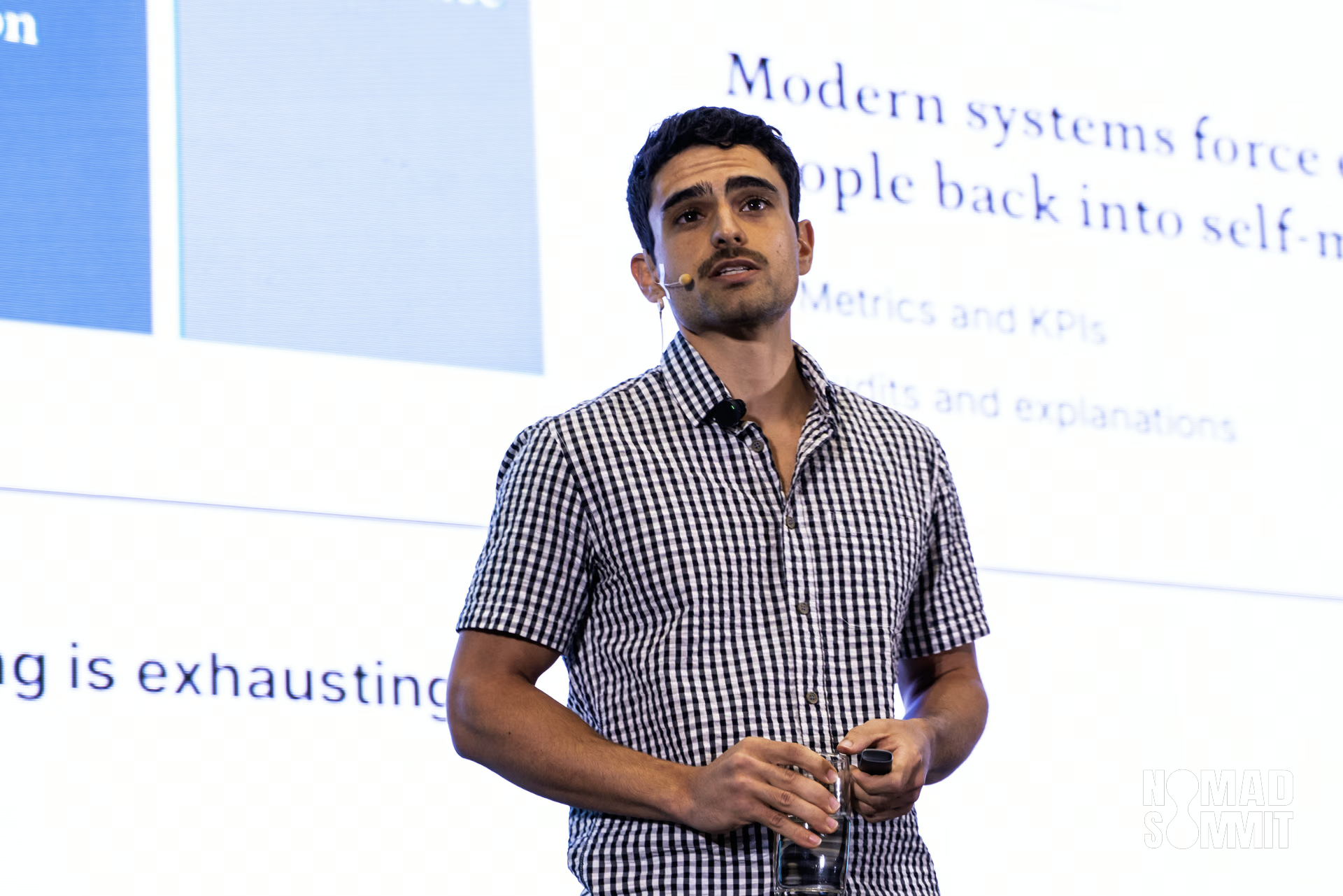
Adam Rajguru came to Nomad Summit not to talk about sustainability or clean tech — the work he's known for — but to talk about this failure mode. The one that targets people who care the most.
When Meaning Starts to Fade
Rajguru opens with a distinction that sounds philosophical but lands practically: there are three kinds of knowing. There's belief — accepting something because someone told you it's true. There's intellectual understanding — the ability to explain and rationalize a concept. And then there's experiential knowing — the kind that lives in the body, that comes from actual contact with something real.
Most of what we absorb about purpose, giving back, and meaningful work lives at the first two levels. We believe it's important. We can explain why. But that's different from having actually felt it.
Rajguru had felt it. After a period of serious personal collapse — a marriage that ended, years of his life coming undone, moving back in with his parents feeling, as he put it, like "a complete shell" — he came through the other side into something he hadn't planned for. A shift in how he experienced himself and others. A softening. A feeling of gratitude and, unexpectedly, compassion.
"It wasn't something I'd tried to get into," he says. "And I thought that would last."
It didn't. Or rather — it lasted long enough for his mind to start building explanations around it. And the explanations slowly became the thing itself.
The Moment Strategy Replaces Care
This is where the talk gets uncomfortably specific.
After his shift, Rajguru returned to his degree, finished it, and found himself drawn to systems thinking — why care gets overridden, why solutions exist but problems persist. His analytical mind, which had been rewarded throughout his life, rushed in to explain the compassion he'd felt. The logic it produced was clean: if the problem is suffering, the solution must be scale. Scale means resources. So build something massive.
He moved to Bali and began developing a technology to convert plastic into fuel. He was preparing a pitch for the president of Indonesia. Everything was stalled — permits delayed, decisions deferred. One week, a landfill caught fire and the air filled with toxic smoke. He'd ordered an air purifier on express shipping while people outside were coughing.
"The contrast between what I was trying to do and what I was so frustrated wasn't working was almost laughable."
But the frustration, he realized, wasn't really about the broken system. It was about attachment. The project had stopped being about the people affected by the problem. It had become about his sense of effectiveness, his identity, his meaning. That's a subtle but significant shift — and it's one that's very hard to catch in yourself while it's happening.
Care Becomes Pressure Becomes Hardness
Rajguru names a pattern he thinks is common among people who genuinely care about what they're doing. Care turns into responsibility. Responsibility turns into pressure. Pressure turns into a kind of tightening — a hardness that wasn't there before.
You see it in non-profits. In organized religion. In corners of movements built around doing good. The original impulse — something felt, something real — gets rationalized into a system. The system generates metrics. The metrics generate obligation. And obligation, sustained long enough, produces burnout.
"Goodness starts to become an optimization treadmill."
For Rajguru, the tightening continued for years. It took the death of his brother — and the grief that followed, which made it impossible to keep pushing — before he could step back and see clearly what had happened. The action hadn't changed much from the outside. But the thing moving it had.
Intention Isn't the Problem
Here's where the talk offers something genuinely useful rather than just diagnostic.
We talk a lot about intention. Set better intentions. Clarify your why. Align your actions with your values. Rajguru doesn't dismiss this, but he thinks it misses the more important variable.
Intention, he says, is like a steering wheel. It tells you what direction you're pointed. Volition is something different — it's the felt energy behind the action. The fuel, not the destination.
And if you're running on dirty fuel — obligation, fear, identity-protection, the need to prove effectiveness — you might not notice for a while. You might go far. You might even accelerate. But the engine is heating up. You're producing things you didn't mean to produce.
This is why intentions alone rarely solve burnout. You can have the right intentions and the wrong volition simultaneously. The steering wheel looks fine. The engine is deteriorating.
Three Diagnostic Signals Worth Paying Attention To
Rather than prescribing solutions, Rajguru offers three signals — not rules, but ways to pay attention to what's actually moving you.
The first is simple: after completing an action, do you feel subtly replenished, or slightly resentful? Resentment isn't a moral failure, he says. It's information. It's telling you something about the fuel source.
The second is how much explanation you need to justify what you're doing. When action flows from genuine contact with a mission, explanation tends to be minimal. When there's a gap between stated purpose and actual motivation, explanation multiplies. More decks. More justification. More internal messaging about why this matters. That proliferation is itself a symptom.
The third is what he calls the self-monitoring test. Are you doing something, or are you watching yourself do it? Constant self-observation — performing care rather than feeling it — is friction. That friction, sustained over time, is what burnout actually is.
Mastery and the Point Where Action Just Flows
Rajguru draws on the philosopher Dreyfus's model of skill development here, and it's an interesting lens. Beginners rely on rules. Competent practitioners deliberate and plan. But experts — genuine masters — don't rely on rules at all. Action just flows from them.
He maps this onto giving back. At the level where it's actually nourishing, you're not trying to give back. You're just giving. The deliberation has dropped away. The self-monitoring is absent. It feels natural because it is natural — it's coming from the right place.
Organisations drift from this too. Companies that lose contact with clear purpose start explaining themselves more — KPIs, audits, mission statements that need reinforcing. That constant self-examination is exhausting at an institutional level for the same reason it's exhausting personally. It's a symptom of disconnection, not a cure for it.
The Fruit and the Memory of the Fruit
One of the more memorable images in the talk is this: meaningful experience is like a fruit. Life gives it to you, you taste it, it's sweet. If you tend to the seed, it can grow. But if you don't, the mind tries to manufacture that sweetness from memory — to force the explanation of the experience back into a felt reality. And it can't. Explanation isn't experience.
"Often we are just left with the memory of the fruit, and we try to live from the explanation."
This is what happens to a lot of people who build professional lives around purpose. They had a real experience — something that genuinely moved them — and then spent years trying to reconstruct it through action and scale, not realising the original contact was fading. The mission continued. The nourishment didn't.
Giving Back as Practice, Not Achievement
The conclusion Rajguru reaches isn't that giving back is bad or that ambition is dangerous. It's that giving back is a virtue in the way love or patience is a virtue — something you develop through imperfect practice, not something you arrive at once and then possess.
Volition can't be manufactured, he says. But you can practice noticing what's actually moving you. And sometimes the signal isn't an outward impulse to help — sometimes it's an inward one. Giving back to yourself isn't a detour from meaningful work. It's often a prerequisite.
There's something clarifying about the way he frames the end point: giving back isn't a trophy or a brand. We're always giving something back — the question is just what. Some of it looks like action. Some looks like restraint. Sometimes the most significant contribution is declining to participate in what deforms you.
The businesses and individuals who sustain meaningful work over time aren't the ones who push harder or optimize better. They're the ones who stay honest about what's actually moving them — and who course-correct early, before the tightening becomes permanent.
Notice where the energy feels forced. Notice where it flows.
That distinction, small as it sounds, is the whole diagnostic.
Sources & References
- Nomad Summit — Annual conference in Chiang Mai for location-independent professionals and entrepreneurs
- TurboScribe — AI-powered audio transcription service used to transcribe this talk