From Hotjar to Hostaway: How Ken Weary Scaled a Fully Remote Culture of 300 Global Teammates
Most advice about scaling remote companies focuses on tools, processes, and org charts. Ken Weary's approach starts somewhere different: with a nine-year-old boy lying on the floor of a Lego store in Prague, spending thirty minutes deciding not to buy anything.
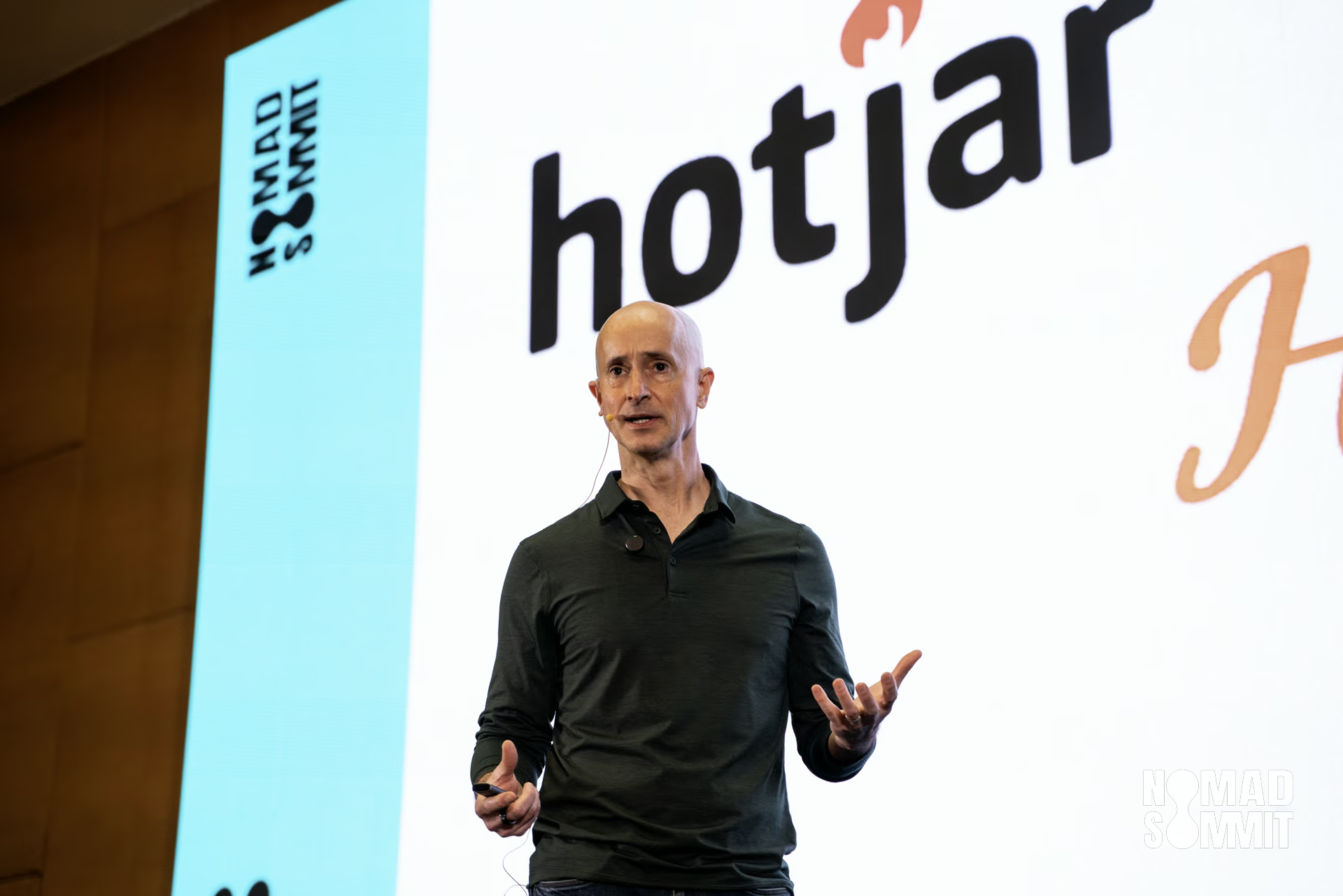
Ken is the COO of Hostaway — a fully remote, no-offices company that last year raised $365 million, crossed a $1 billion valuation, and became the first unicorn in the vacation rental software industry. Before that, he was COO at Hotjar, which he helped scale from 14 people to 400 while installed on more than 1.3 million websites. Both companies built significant things without a single permanent office.
But the through-line of Ken's talk at Nomad Summit wasn't really about either company. It was about what he learned from nearly a decade of nomadic family life — traveling with his wife and two kids through every country in mainland Central America, then across Europe and Africa, across more than 40 countries in total — and how those lessons directly shaped how he builds and runs distributed teams.
Frugal Is Not the Same as Cheap
The Lego story is worth telling in full, because it captures what Ken means by frugality better than any business framework could.
His son Tag, five years old at the time, walked into the store, found a Lego set, sat down with it, studied it for half an hour, then put it back on the shelf and walked away. When Ken asked why, Tag said the set wasn't as good as the one he already had in his bag. He'd mentally deconstructed it, built it in his head, played with it, and concluded it wasn't worth the trade-off — not just financially, but spatially. Buying the new set meant giving up the old one. It wasn't worth it.
That kind of reasoning, Ken argues, is exactly what's missing in a lot of business spending decisions.
Frugal isn't about minimizing every cost. It's about applying real critical thinking to where money goes, and spending it where it actually matters. The Hotjar logo — a licensed flame icon — cost 99 cents. The Hostaway logo was bought on Fiverr for five dollars. It's still the logo on a billion-dollar company. The money saved on those decisions went toward engineering, toward talent, toward things that actually moved the needle.
Being cheap is reflexive. Being frugal is intentional. The difference shows up most clearly when you're under pressure to spend fast.
Usually — Not Always — Work Remotely
Ken makes a point that often gets lost in the remote-work debate: remote-first doesn't mean never in person. It means the default is remote, but the exceptions are intentional.
His family, while traveling, would periodically join 150 other nomadic families for camping trips, ski weeks, and gatherings in places like Bansko, Bulgaria and a locals island in the Maldives. The point wasn't luxury. It was the irreplaceable experience of being physically together with your people.
Hostaway does the same. At least once a year, the entire team gets the opportunity to meet in person — Barcelona, Sri Lanka, Austin, Croatia, San Antonio. Not because remote work has failed, but because there are things that in-person time does that nothing else replicates. A handshake. A shared meal. The ability to read someone's expression when they're struggling with something.
The physical gathering isn't a correction to remote work. It's what makes remote work sustainable over time.
Standards Create Freedom, Not Bureaucracy
When you travel constantly, you encounter standardization everywhere — plug types, currencies, SIM card formats. You don't decide what the electrical outlet looks like in Thailand. You just adapt to what's there, and it works because everyone agrees on the same system.
Ken applies this directly to how Hostaway operates. The company doesn't mandate where people work or, in most cases, when. But it does mandate how people communicate. Slack usage at Hostaway is prescriptive — there are explicit guidelines about how it's used, how channels are structured, how information flows. That consistency means 300 people across dozens of time zones can navigate a shared communication environment without constantly losing things or each other.
The distinction Ken draws is useful: define your non-negotiables, define your standards, and then make clear where the freedom lives. Without that structure, freedom becomes noise. The best remote teams know exactly which rules are fixed and which ones they get to write themselves.
Transparency Reduces Imposter Syndrome
There's a body of research suggesting that remote workers are more likely to experience imposter syndrome than their in-office counterparts. The reason makes intuitive sense: when you can't see your colleagues regularly, you lose access to the small non-verbal signals that tell you you're doing fine, that others find your work credible, that you belong.
Ken's answer to this isn't more one-on-ones or more Zoom calls. It's radical transparency.
Hostaway doesn't operate on a need-to-know basis. Information doesn't sit behind departmental firewalls. If someone might need to know something at some point, the default is to make it available to everyone. The company's changelog is public, even for customers — every product update, released weekly, visible to anyone who wants to see it.
The philosophy is that when everything is out in the open, people can orient themselves. They know where the company is going, what's changing, what decisions are being made and why. That visibility is what levels the playing field in a distributed environment. It's harder to feel like an outsider when you can see the whole field.
Flexibility Requires Letting Go of the Plan
Ken arrived in Fez, Morocco alone, a few days ahead of his family, needing to find accommodation for five people for five weeks. He searched inside and outside the medina. Nothing worked — too far, too crowded, wrong smell, wrong size. Eventually, he asked the hostel caretaker, Yusuf, if he had any ideas.
Yusuf had an idea. His family owned the largest private palace in Fez.
Ken and his family spent five weeks there. He's still in contact with the family. None of it would have happened if he'd pre-booked the trip, locked in a place before arriving, and closed off the possibility of wandering into something better.
This maps directly to how Hostaway builds product. The company has a north star — the outcomes it wants, the competitive ground it wants to win, the direction it's heading. But it doesn't pretend to know exactly how it'll get there. Every week, updates ship. The changelog grows. The product evolves in response to what customers actually say and do, not in response to a roadmap written six months ago.
Hostaway started as a channel manager — software that syncs vacation rental listings across Airbnb, VRBO, and similar platforms. The founders thought that was the product. But as they listened to customers, they discovered what customers actually needed was a full property management system: occupancy tracking, communications, cleaning schedules, calendar management. The product became something much larger because they stayed flexible enough to follow where the real need was pointing.
Always Be Learning — and Mean It
Ken's daughter Ella became a certified scuba diver at age ten, in Honduras, on the second-largest reef system in the world. She's now twenty, studying marine biology at the University of Plymouth. The trajectory traces back directly to that moment of curiosity — noticing the divers, wondering what they were seeing, and finding a family willing to lean into it rather than schedule it for later.
The lesson Ken draws for business isn't complicated: learning mode has to be a genuine operating principle, not a value listed on a website.
At sixteen, Ella wanted her first job while the family was living in Portugal. She didn't speak Portuguese. Rather than wait for something to appear, she pitched an idea to an online learning platform: she'd teach marine biology to kids aged eight to twelve, drawing on years of firsthand observation across multiple continents. She didn't ask to be paid — she asked for a tuition discount. The platform said yes. Ken paid less. Ella got her start.
That's the practical shape of thinking differently: not waiting for the path that already exists, but building one from what you actually know.
Think Differently — Remote Enables Things Offices Can't
A common criticism of remote work is that it can't replicate what an office provides. Ken's response is direct: that's true in both directions.
During Hostaway's Halloween costume contest, Ken — working from an Airbnb — wrapped himself in a green blanket, turned himself into a live green screen, and effectively became a visual effect. You cannot do that in an office. Not practically. Not with the same spontaneity. The constraint of being somewhere unfamiliar became the creative resource.
Remote work doesn't just replicate office culture at a distance. It produces its own culture, its own affordances, its own kinds of creativity and connection. The companies that treat it as a lesser substitute for in-person work miss that entirely.
All In or All Out
Ken's final point is the most direct. The nomadic family life ended because his son Tag wanted a dog. Dogs slow you down. The family voted, more or less, and they settled. They still travel constantly, but they stopped being nomads because one person wasn't fully in anymore — and you can't sustain that for long without fracturing the unit.
He applies the same logic to workplace structure. His view is unambiguous: hybrid work is inefficient by design. Not because either model is wrong, but because mixing them breaks the coherence of both. Communication splits across channels. Cultural norms become inconsistent. People who are in the office and people who are remote experience fundamentally different versions of the same company, and that gap compounds over time.
Both models — full office and fully remote — work. What doesn't work, in Ken's experience, is trying to split the difference indefinitely.
The companies that commit fully to one model, and build everything around that commitment, tend to be the ones that figure out how to make it work exceptionally well. Hostaway is evidence of what that looks like at scale.
Sources & References
- Hostaway — Vacation rental property management and channel manager software
- Hotjar — Website behavior analytics and user feedback platform
- Fiverr — Freelance services marketplace
- Deloitte Technology Fast 500 — Annual ranking of the fastest-growing technology companies in North America