
Before It's a Trend: How to Spot Opportunities Early and Build What's Next
People often discover opportunities only once they’re obvious. By then, the window has usually narrowed considerably — and the advantage belongs to whoever moved earlier.
The harder question is how to see what's coming before it has a name. Before the think pieces. Before the VC rounds. Before the LinkedIn posts declaring it inevitable.
Dr. Quinn Button — consumer behaviour researcher, former VP of Growth at NFT NYC, investor, and full-time digital nomad — gave a keynote at Nomad Summit Chiang Mai that tried to answer exactly that. Her argument isn't about trend forecasting or market research in the traditional sense. It's about paying attention in a very specific way, and understanding why nomads are structurally better positioned to do it than almost anyone else.
What a Signal Actually Is
The word "signal" gets thrown around loosely. Button uses it precisely.
A signal is an early behavioural change. Not a conversation about change. Not an article predicting change. Someone actually doing something differently — often before they can explain why.
A trend is what happens when enough of those signals stack up. And if a trend sustains long enough, it goes mainstream. That's the whole arc. The opportunity lives in the gap between signal and mainstream — which is also the gap most people miss entirely because they're not looking for it yet.
Then there's hype. Hype is attention without behavioural change. And distinguishing the two is where it gets genuinely difficult.
Button's case study here is pointed: NFTs. She ran growth for the largest NFT event in the world — 22,000 attendees in June 2022, Times Square taken over, every major Fortune 500 company lurking in some capacity. And she was standing on stage at the time saying that 90% of it was probably going to zero. (Gary Vee said 99%. He was closer to right.)
But buried inside all that hype were real signals. People were coming out of pandemic isolation desperate for identity, for belonging, for community with participation at its core. The JPEGs mostly failed. The underlying human need didn't. The companies that understood the signal — and ignored the hype — extracted something durable from the whole episode.
That distinction matters. Hype can contain real signals. You have to know what you're actually looking at.
Why Nomads Have a Structural Edge
Button's strongest claim is also her most counterintuitive one: the nomadic lifestyle isn't just personally fulfilling. It's a cognitive advantage for spotting what comes next.
The mechanism is neuroplasticity. When you enter a familiar environment repeatedly, the brain shifts into efficiency mode — filtering for what's already known, tuning out novelty. It's comfortable. It's also terrible for innovation.
Enter a new city, a new social context, a genuinely unfamiliar culture — and something different happens. The brain increases attention, pattern recognition, and learning speed. It's constantly scanning, searching for meaning, building new connections. Novelty forces awareness. Contrast sharpens perception. Uncertainty accelerates learning.
Which sounds slightly abstract until you consider the practical implication: nomads face friction earlier than most people.
Payments that don't quite work. Visa systems with baffling gaps. Collaboration tools built for people with a fixed address. Identity infrastructure that assumes you stay put. These aren't minor inconveniences — they're unmet needs that the mass market won't encounter for another few years. And because nomads feel that friction first, they also innovate around it first.
Button calls this being a "lead user." It's not just a nice way to describe the lifestyle. It's a real position in the innovation cycle — and it comes with actual leverage, if you know how to use it.
Signals vs. Hype: What to Actually Look For
Knowing that signals exist isn't enough. You need to know what they look like in the wild.
Button names three categories worth paying close attention to.
Repeated workarounds. When people invent their own solutions because nothing else fits, that's a signal. Someone creates an unofficial Google Sheet to track side events at a conference because the organiser didn't provide one. A workaround that keeps appearing across different contexts is a product waiting to be built. The workaround is the demand proof.
Emotional spikes. Emotion is energy, and energy signals unmet or newly met needs. Strong frustration, unexpected delight, relief, pride — these are all data points. Button describes landing at Bangkok airport and discovering a dedicated credit card tap lane for the transit system. It sounds small. The delight she felt was real. That kind of reaction, multiplied across many people, is something worth taking seriously.
Identity language. Listen for phrases like "I'm the kind of person who…" or "people like us" or "this feels very me." When people start organising their sense of self around a behaviour or a product or a community, belonging is forming. That's an early signal that something is taking root — not just being tried.
And then there's what she calls "friction at the edges." Systems that almost work. Payments. Visas. Collaboration. Trust. Community coordination. How many hours have nomads collectively spent figuring out the same obscure LLC-and-PO-box configuration in Florida? The same research, done thousands of times, by thousands of people who don't know each other are doing it simultaneously. That's not just annoying. It's an opportunity.
The Gartner Hype Cycle — and Where the Real Window Is
Button walks through the Gartner Hype Cycle not as a cliché but as a practical orientation tool. The arc is familiar: technology trigger, peak of inflated expectations, trough of disillusionment, slope of enlightenment, plateau of productivity.
Most ideas fail not because of poor execution. They fail because they were built without real demand — either too early for the market to understand them, or too late to matter. Signal spotting is what saves you from both failure modes.
The real window — where opportunity is genuine but competition hasn't arrived yet — sits somewhere in the early slope of enlightenment. Past the trough, past the graveyard of hype casualties, but before the plateau where the market is mature and margins have compressed. The nomad advantage is being positioned to see that window forming.
AI is Button's current case study for this arc. Not quite plateau yet. Still enough slope remaining that early positioning matters. And AI changes the underlying economics of opportunity-spotting in a way that's worth sitting with.
What AI Actually Changes
If AI makes building cheap — and it increasingly does — then the scarce resource shifts.
When anyone can spin up an app, the bottleneck isn't code. It's understanding. The ability to read human behaviour accurately, to identify real friction versus imagined friction, to know whether a signal is meaningful before committing to building something around it — that becomes the actual competitive advantage.
Button puts it bluntly: AI lowers the cost of creation, so human insight becomes the scarce input.
Her PhD was quantitative. She used eye-tracking technology to study adoption patterns for innovations across everything from e-commerce to electric vehicles. But she found herself pulled toward the qualitative — toward the messier, harder-to-scale work of actually understanding why people do what they do. The mixing of both is where the sharpest insights tend to live.
AI doesn't yet understand context the way a person who's lived across cultures does. It doesn't feel friction. It doesn't experience delight at a tap lane in Bangkok. That gap is real, and right now it's an advantage worth using.
The Signal-to-Build Loop
Button's framework for turning observation into action is deliberately simple. She calls it the signal-to-build loop.
First: scan and score. Look for frequency — how often does this signal appear? Intensity — is the frustration mild or is it actively disrupting people's workflows? Context shift — does this pattern appear in multiple places, or is it specific to one environment? And workarounds — what are people already doing to compensate for the gap?
Scoring matters because not all signals are worth pursuing. Some are too niche. Some are real but not scalable. The scoring step is about honest triage before you invest anything.
Second: turn signals into problems. The framing she suggests is simple: "People like X in context Y struggle with Z." Digital nomads in Chiang Mai struggle with ___. Fill in the blank from what you've actually observed. This step is where abstract observation becomes a legible problem that can be tested.
Third: test, fast. Landing pages. MVPs. Conversations. The goal isn't praise — it's pull. Someone saying "that was really interesting" is not the same as someone immediately trying to use what you've built. Tests should take days, not months. A cohort of around 20 people over two weeks is enough to generate a real signal if you're solving the right problem for the right people.
Fourth: scale or kill. Scale only when behaviour proves demand. And kill ideas early — not as failure, but as efficiency. Getting attached to a hypothesis that doesn't bear out is how resources get wasted. Killing it cleanly is the smart move.
The Belonging Engine
One thread runs through everything Button talks about: community, and how it actually forms.
She describes what she calls the belonging engine. It starts with shared identity — a sense of "we." Then ritual — the repeated behaviours that make membership visible. Reward — what participants actually get from showing up. And eventually, reputation — the outward signal that attracts more people into the orbit.
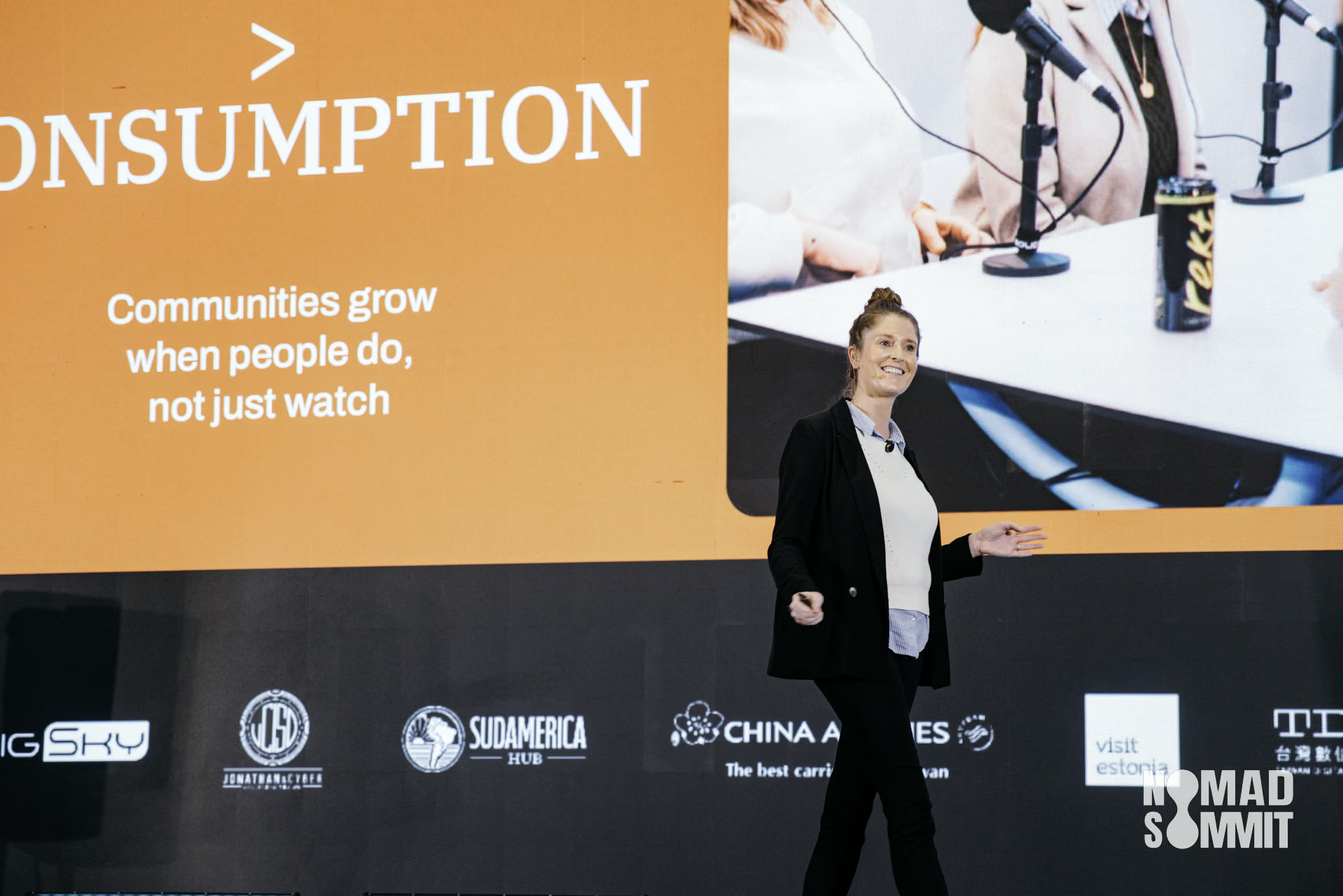
The NFT example again: the JPEGs were speculative noise. But the communities that formed around them — built on shared identity, repeated participation, visible membership — those were something real. The signal that survived the crash wasn't about blockchain ownership. It was that participation beats consumption. Communities grow when people do things together, not when they passively observe.
Nomad Summit, by its nature, is a live demonstration of this. People choosing to show up — to a conference, to a side event, to a pool party where the real conversations happen — are doing something that passive consumption can't replicate. That's where signals travel. That's where the early behavioural changes become visible to people positioned to notice them.
What to Do This Week
Button ends practically, which is the right way to end.
Keep a signal journal. Not formal research — just notes. Observations from conversations. Moments of friction or unexpected delight. Things you noticed in two different places that surprised you. The act of writing it down forces clarity about what you actually observed versus what you interpreted.
Score your signals before you build anything. The scoring step is a filter. Most signals won't pass it. The ones that do are worth a test.
Run one test on one signal. Twenty people, two weeks. See if there's pull.
The bigger point is this: as a nomad, you're already living in environments that surface early signals. You're already encountering friction that most people won't face for years. The question is whether you're treating that as data.
The future is already visible in the gaps, the workarounds, and the emotional spikes of daily life. The advantage goes to whoever learns to read it first — and has the discipline to test before they build.
Sources & References
- Gartner Hype Cycle — Gartner's research framework for tracking the maturity and adoption of emerging technologies
- NFT NYC — Annual NFT and Web3 conference held in New York City; one of the largest blockchain events globally
- Life Out of the Box — Dr. Quinn Button's travel and lifestyle brand, co-founded with her husband